Beginner's Glossary: Essential Ski and Snowboard Terms
You don't master the ski vocabulary ? When someone talks about carving on the frontside or choosing the right flex for your boot, are you lost? Don't worry: Ekosport-Rent has prepared a glossary for you with all the vocabulary to know when you go on a ski holiday!
In summary
Are you new to skiing or snowboarding and finding some technical terms incomprehensible? This Ekosport-Rent glossary explains the essential vocabulary of winter sports, from disciplines like freeride, freestyle, all-mountain, or telemark to equipment elements like camber, rocker, flex, and edges. It also defines the main gliding techniques, terms related to snow and weather, as well as specific snowboarding vocabulary. Also find maintenance and safety concepts like sharpening, waxing, and avalanche transceivers. Consult the complete glossary to master ski vocabulary.
Differentiating disciplines in winter sports
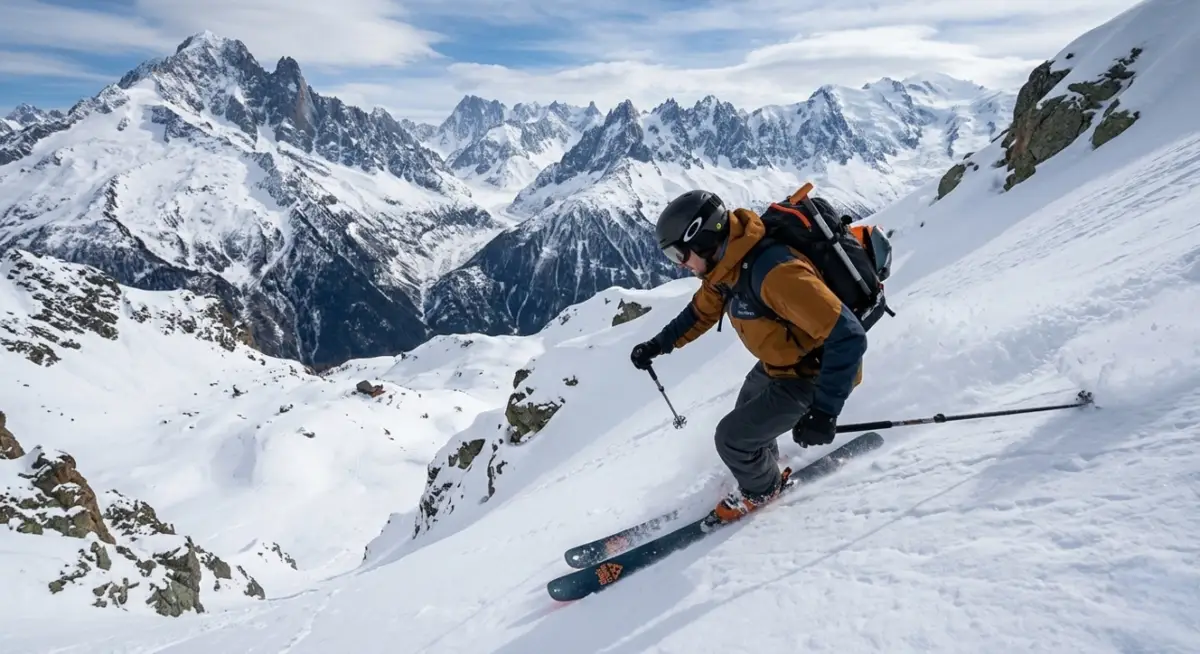
All-mountain : practice of skiing both on-piste and off-piste. An all-mountain ski is versatile, offering good sensations on groomed snow as well as in powder.
Backcountry : freeride skiing, which consists of integrating jumps and tricks freestyle on natural elements. Note that in English, when we talk about « backcountry skiing », it rather refers to ski touring (climbing with skis equipped with climbing skins and descending on-piste).
Freerando : discipline between freeride and ski touring, where you use ski lifts, then you cover short distances to find powder zones and descend off-piste.
Freeride : skiing off-piste and marked trails, in powder snow.
Freestyle : a style of skiing based on performing jumps and tricks on snowpark features or in natural environments. If you are new to freestyle, here are some important terms to know:
Big Air : a large jump that allows you to launch into the air to perform tricks. When the landing features an inflatable mattress, it's called a 'Big Air Bag'.
Half-pipe : a run shaped like a half-tube, allowing for tricks on either side of the descent.
Kick : a snow hump that serves as a jump.
Rail : a metal bar in a snowpark, on which you slide on skis or a snowboard.
Slopestyle : an acrobatic downhill course, made up of different features on which riders perform tricks and jumps.
Monoski : a type of ski consisting of a single board on which both feet are placed side-by-side, facing downhill.
Classic cross-country skiing : cross-country skiing where one moves by practicing the alternating stride (moving by alternating left and right foot) or by pushing solely with poles, staying in parallel tracks.
Skate cross-country skiing : cross-country skiing where one moves with the skater's stride, meaning placing the skis in a V-shape, with a movement similar to ice skating or rollerblading.
Splitboard : equipment halfway between skis and snowboard, it is a board that can be divided into two. It is used for backcountry snowboarding », by ascending with two skis and descending on a single board.
Telemark : the practice of free-heel skiing, between classic alpine skiing and Nordic skiing.
Understanding the composition of a ski or a snowboard
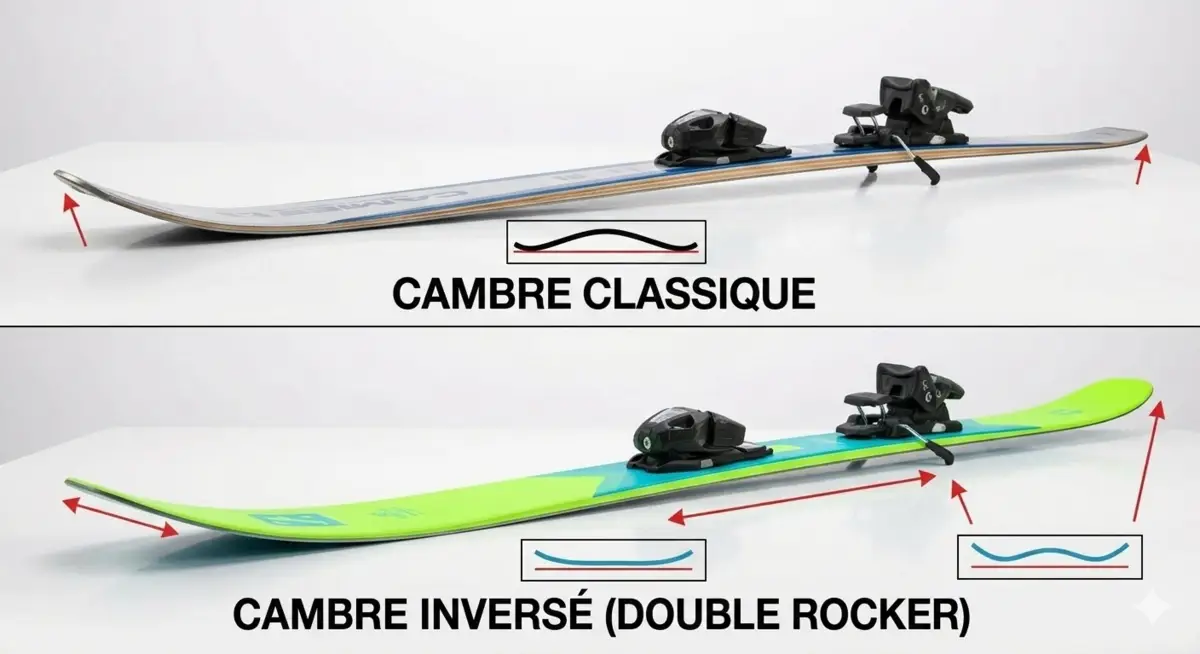
Camber : natural curvature of a ski or snowboard, the shape it takes when laid flat, without any weight on it.
Edge : metal edge that borders the base of the ski or snowboard.
Binding : system that allows to attach the boot and the ski. It must be correctly adjusted to release when necessary (impact, fall, etc.). We also refer to binding for the part that connects the snowboard and the boot. In this case, the binding adjustment aims to ensure the ideal configuration according to morphology and level.
Flex : index of stiffness of the ski boot. A light flex is recommended for beginners and a higher flex for experienced skiers.
Core : heart of the ski, made of wood, metal or plastic, which gives it its rigidity and solidity.
Rocker : a ski with a front rocker has the tip that rises earlier than with a classic camber. There are also skis with double rocker, meaning a rise at the tip and tail.
Sole : the part located under the ski, in contact with the snow.
Tip : the front part of the ski, curved upwards.
Tail : the rear part of the ski, curved upwards (sometimes referred to as the "rear tip").
Twin tip (or twin shape or double tip ski) : a ski or snowboard shape designed symmetrically, allowing to slide forwards or backwards.
Understanding the terms to talk about weather or snow
Dump: heavy snowfall.
Whiteout: a day of poor visibility, where the cloudy sky does not clearly stand out from the snow-covered ground.
Chopped snow: fresh snow (ungroomed) in which one sees and feels asperities, due to the multiple passages of other skiers, snowboarders or hikers.
Pow or pow-pow: terms that designate powder snow (light snow, which has just fallen and has not been transformed).
Pea soup: dense fog, which impairs visibility on the slopes.
Knowing how to use the right terms for different sliding techniques
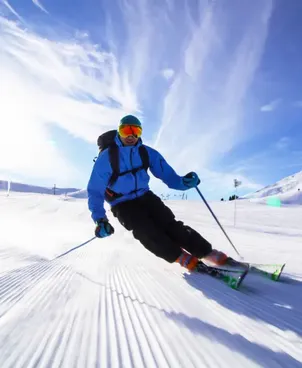
Carving : a method of turning that involves pressing heavily on the downhill ski to anchor the edges in the snow. When carving, we can also talk about "cut turns".
Snowplow : a technique reserved for beginners to brake and turn, forming a V with the feet (bringing the tips together and spreading the heels apart).
Edge fault : pressing on the uphill ski instead of the downhill ski when carving, which leads to imbalance, or even a fall.
Short turn : a descent technique that consists of chaining very short turns, keeping the torso and shoulders facing the slope.
Schuss : a straight descent, with skis perfectly parallel, allowing maximum speed.
Switch (or fakie) : skiing backward, mostly practiced in freestyle. In skiing, it involves skiing downhill backward, and in snowboarding, attacking the slope with the foot that is normally at the back of the board.
Mastering the vocabulary specific to snowboarding
Backside : position with your back to the slope, with your torso facing uphill.
Boot : snowboard boot
Falling Leaf : beginner's gliding technique, which consists of descending the slope across, then changing direction while staying on the same edge, without turning the board towards the slope. The movement alternates between right and left, like a falling leaf.
Frontside : position facing the slope, with your torso oriented downhill.
Goofy : snowboarder's position with the right foot forward on the board.
Regular : snowboarder's position with the left foot forward on the board.
Stance : distance between the front foot and the back foot.
Know other common words used in winter sports
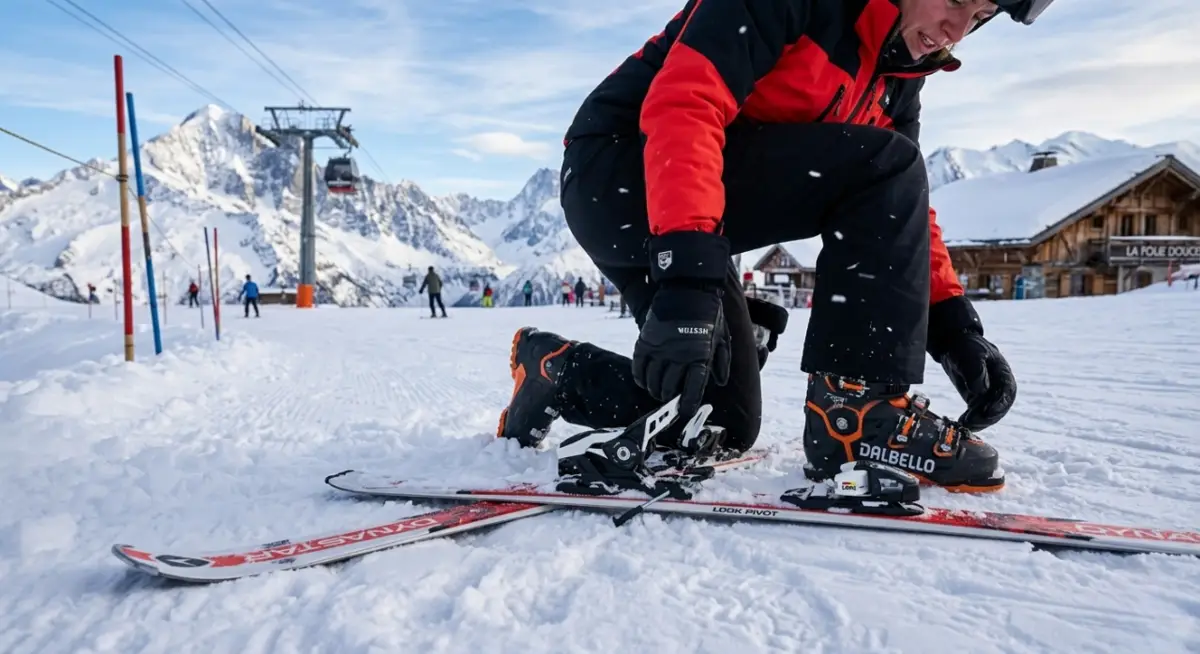
Edging : an operation that consists of maintaining the edges of a ski or snowboard, to regain a sharp edge and an ideal angle. Edging is essential for good grip on the snow.
Unclip : remove the ski boot from the binding. You unclip when you voluntarily remove your ski or when the ski comes off following the release of the binding in case of shock, fall, etc.
Planing : the act of getting the tip out of the snow. The planing capacity is particularly important in freeride, to be able to effectively progress in deep powder snow.
AVS : acronym for « Avalanche Victim Detector », the AVS device is a transceiver to find people buried under the snow.
Waxing : also called « wax », it is the product applied to the ski base to ensure good glide and create a protective layer.
Resurfacing : a process of ski repair, by which the entire base is covered, so that it regains a smooth, almost new appearance.